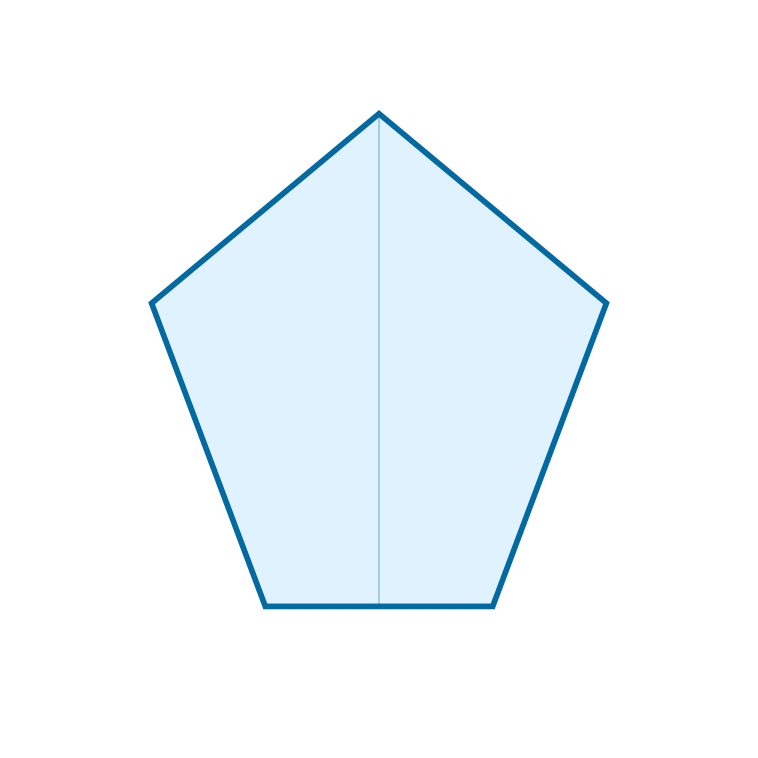
amorphous Simulant amber simulant
Ambroid (Pressed Amber)
Formula Compressed and fused amber chips (same chemical composition as amber — fossil resin; succinite for Baltic amber)
Crystal Structure
 #! Species: Ambroid (reconstituted/pressed amber)
#! System: Amorphous (fossil resin)
#! Habit: Massive; streaky colour zones from compression
amorphous[resinous]:{massive}
amorphous
none
{massive}
Quick Facts
Hardness
2.0
Specific Gravity
1.05
Refractive Index
1.53
Optical Character
Isotropic
Physical Properties
- Crystal System
- amorphous
- Hardness (Mohs)
- 2.0
- Specific Gravity
- 1.05
- Cleavage
- None
- Fracture
- Conchoidal
- Lustre
- Resinous
Optical Properties
- Refractive Index
- 1.53
- Birefringence
- 0
- Optical Character
- Isotropic
- Fluorescence
- Blue-white (LWUV; similar to amber)
Origin & Identification
- Origin
- Simulant
- First Produced
- 1880
- Diagnostic Features
- Elongated flattened bubbles (vs spherical in natural amber — most diagnostic under microscope); streaky colour zones at chip boundaries; angular junction planes between compressed fragments; FTIR: same as amber (not distinguishable by FTIR alone); float/acetone tests same as amber
Characteristics
Colours
YellowOrange-yellowOrange; may show streaky swirling colour distribution from compression
Common Inclusions
Elongated bubbles (from pressing process; diagnostic); streaky flow-lines; angular fragments of original amber chips visible under magnification at junction zones
Notes
Ambroid is a simulant produced by compressing/fusing small amber chips and fragments under heat and pressure (autoclave compression); also called "reconstituted amber" or "pressed amber." Same chemistry as amber; FTIR spectrum matches amber (Baltic succinite shoulder ~1150 cm-1 present). Main diagnostic: elongated/flattened bubbles from pressing process (natural amber has round spherical bubbles); streaky colour zones at chip boundaries visible under microscope; angular junction planes between compressed fragments. Float test identical to amber (SG 1.05-1.09). RI identical to amber (1.530-1.545). Acetone test: ambroid resists acetone (like amber; fully polymerised) — distinguishes from copal. Gemmological knowledge from Read 7th ed. (DOI 10.4324/9780080507224) [PARTIALLY_SUPPORTED]. Introduced commercially c.1880s when amber scrap from cutting was compressed to make larger pieces. Note: ambroid is NOT an imitation of a different material — it IS amber (same composition) but reconstituted; the "simulant" classification reflects its commercial deception as "natural unmodified amber." Target: natural amber.
Related Minerals
Other minerals in the amorphous system
Bone (Ivory Simulant)
Ca5(PO4)3(OH) (hydroxyapatite; same general composition as ivory dentine) in collagen matrix; technically microcrystalline hydroxyapatite but gemologically treated as amorphous/aggregate biomineral
Chalcedony (Botryoidal)
SiO2
Chalcedony (Massive)
SiO2
Chrysocolla
(Cu,Al)2H2Si2O5(OH)4.nH2O
Copal (Amber Simulant)
Partially polymerised plant resin (labdanoid diterpenes; younger resin; not fully matured/polymerised)
Coral
CaCO3 (calcareous; polycrystalline calcite + organic matrix); black coral = gorgonin protein