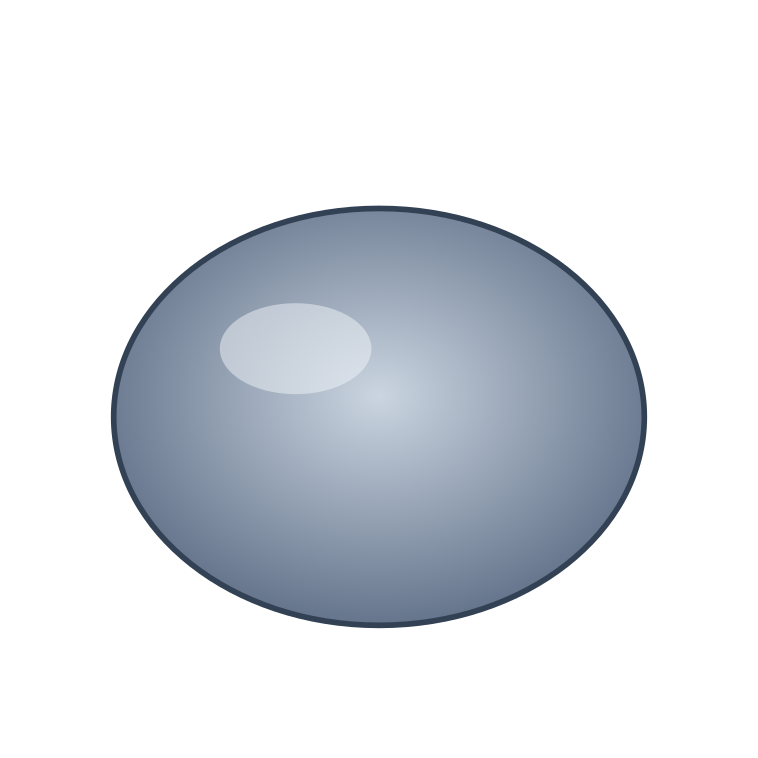
amorphous Mineraloids
Obsidian
Formula SiO2 (55-75 wt%) + Al2O3, FeO, MgO, CaO, Na2O, K2O (rhyolitic volcanic glass; variable)
Crystal Structure
 #! Species: Obsidian (volcanic glass)
#! System: Amorphous (mineraloid)
#! Habit: Massive with conchoidal fracture; flow structures
amorphous[glassy]:{massive}
amorphous
none
{massive}
Quick Facts
Hardness
5.0
Specific Gravity
2.33
Refractive Index
1.48
Optical Character
Isotropic (ADR in stressed varieties)
Physical Properties
- Crystal System
- amorphous
- Hardness (Mohs)
- 5.0
- Specific Gravity
- 2.33
- Cleavage
- None
- Fracture
- Conchoidal (sharp edges; most diagnostic macroscopic feature)
- Lustre
- Vitreous to sub-vitreous
Optical Properties
- Refractive Index
- 1.48
- Optical Character
- Isotropic (ADR in stressed varieties)
- Pleochroism
- None
Characteristics
Colours
Black (magnetite crystallites)Mahogany (red-brown hematite patches in black matrix)Snowflake (cristobalite spherulites in black matrix)Golden or silver sheen (oriented gas bubble layers)Rainbow/fire (thin-film interference in layered glass)
Localities
Mexico (Hidalgo, Jalisco, Michoacan; rainbow and snowflake varieties)USA (Glass Buttes Oregon; Obsidian Cliff Wyoming)Armenia (Satanakar, Geghasar; major prehistoric trade source)Iceland (Hekla volcano)Italy (Lipari, Sardinia)Ethiopia (Hareri region; East African Rift)New Zealand (Mayor Island)
Common Inclusions
Sub-microscopic magnetite/hematite crystallitesCristobalite spherulites (snowflake obsidian)Oriented gas bubble layers (sheen varieties)Flow bandingPhenocryst fragments (sanidine, plagioclase, pyroxene)
Known Treatments
Surface coatings (occasional; detected by acetone test)
Crystal Forms
massive
Diagnostic Features
Conchoidal fracture (primary); flow banding under magnification; RI 1.48-1.51; SG 2.33-2.50 (lower than most gem minerals); isotropic under polariscope
Notes
Not an IMA mineral species; natural volcanic glass (mineraloid) formed by rapid solidification of rhyolitic to rhyodacitic lava. IMA-approved: N/A. Flow banding and conchoidal fracture confirmed by Zook (1973) Journal of Gemmology (DOI 10.15506/jog.1973.13.6.220) [VERIFIED]. Van Nostrand's Scientific Encyclopedia chapter (DOI 10.1002/0471743984.vse5189) [VERIFIED]. RI and SG from Read 7th ed. (DOI 10.4324/9780080507224) [PARTIALLY_SUPPORTED]. Snowflake obsidian: cristobalite variety. Sheen: oriented gas bubble interference.
Related Minerals
Other minerals in the amorphous system
Ambroid (Pressed Amber)
Compressed and fused amber chips (same chemical composition as amber — fossil resin; succinite for Baltic amber)
Bone (Ivory Simulant)
Ca5(PO4)3(OH) (hydroxyapatite; same general composition as ivory dentine) in collagen matrix; technically microcrystalline hydroxyapatite but gemologically treated as amorphous/aggregate biomineral
Chalcedony (Botryoidal)
SiO2
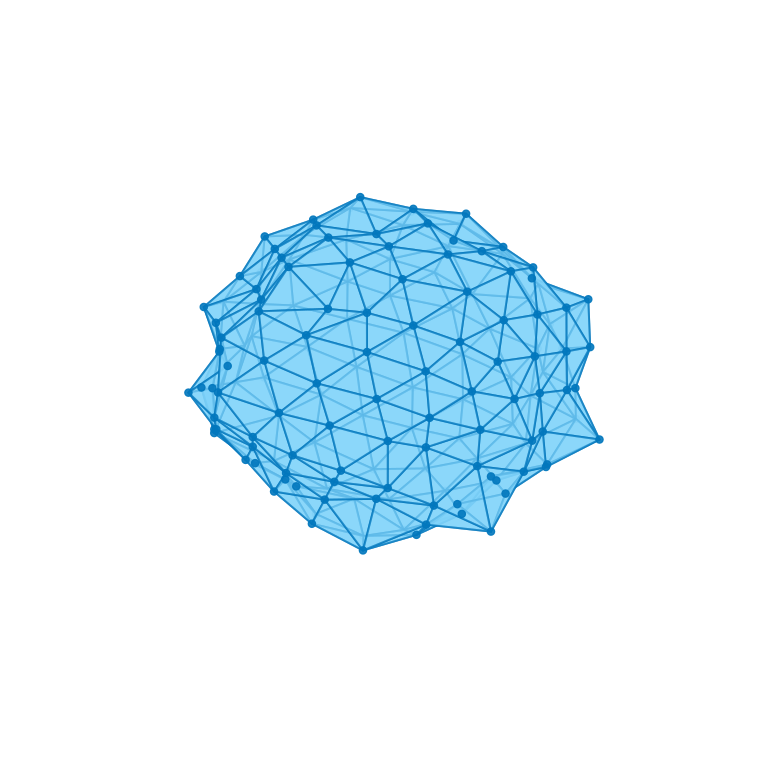
Chalcedony (Massive)
SiO2
Chrysocolla
(Cu,Al)2H2Si2O5(OH)4.nH2O
Copal (Amber Simulant)
Partially polymerised plant resin (labdanoid diterpenes; younger resin; not fully matured/polymerised)